Tecar Therapy
How does tecar therapy work?
Tecar therapy is a form of endogenous thermotherapy that uses radiofrequency energy to generate heat inside the tissue itself, rather than warming it from the outside. It belongs to the same family as diathermy, but the capacitive and resistive modes let the therapist decide how deep the energy is delivered.
Because the heat is produced within the tissue, blood flow and metabolic activity increase in the treated area, which supports the body in its own repair process.
The method is used in orthopaedics, neurology, rheumatology and sports rehabilitation, and it is normally one part of a wider treatment plan that also includes kinesitherapy and electrotherapy.
Unlike infrared lamps, laser or ultrasound, whose effect is limited to the surface layers because the energy arrives from outside the body, tecar therapy reaches deeper structures and its analgesic effect can last up to 48 hours after the session.

Which conditions it treats
Tecar therapy offers three modes of heat delivery: hyperthermia (adding heat), athermia (no perceptible heat) and homeothermia (thermal biostimulation of the tissue). The therapist selects the mode according to the diagnosis and whether the problem is acute or chronic.
The range of use is wide. Tecar is applied across injuries and conditions of the musculoskeletal system, with good results in reducing pain and swelling and in improving nerve conduction.
In rheumatology, where warm procedures are indicated, it can help reduce chronic pain in joints and surrounding structures and improve mobility. In neurology it is used where muscle tone is affected, often as preparation before exercise therapy, and in peripheral nerve conditions such as sciatic pain. It is also applied in facial nerve palsy, where one side of the facial musculature is weakened.
Sports medicine is where the method is used most. Deep heat in muscle and connective tissue reduces pain and muscle tension, improves joint mobility and increases the elasticity of ligaments, which is why it is often combined with rehabilitation after strains and partial tears.
In practice it is most frequently requested for shoulder pain, knee pain, elbow pain and problems with the Achilles tendon.
What a tecar therapy session looks like
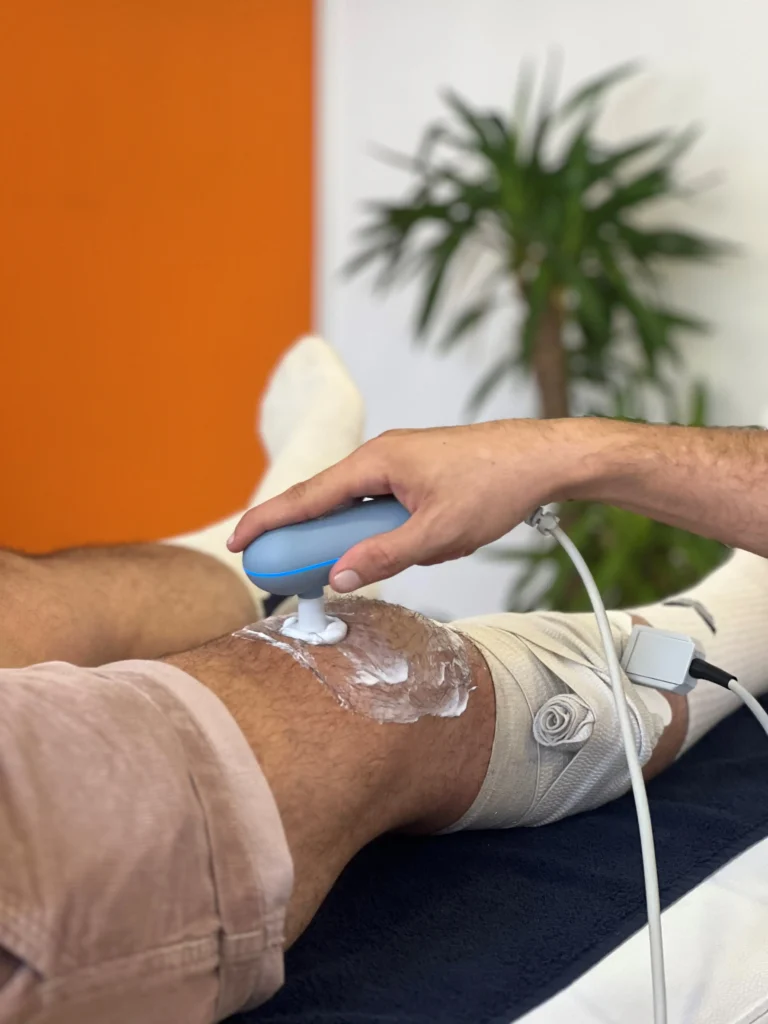
The treatment is delivered through two electrodes connected to a radio wave generator. A conductive cream is applied to the skin, the therapist moves the electrode over the area, and the tissue warms from within. One electrode works capacitively, the other resistively, which changes how deep the energy travels.
A session can be combined with light massage where there is muscle tension, with passive stretching where mobility needs to improve, and with active muscle contraction, which helps the muscle release afterwards.
Many people notice a difference after the first session, usually less pain and easier movement. How quickly that happens depends on the diagnosis and on how long the problem has been present.
What makes tecar different from other heat treatments
Surface heat treatments warm the skin and the layers just beneath it. Tecar creates the heat inside the tissue, so it reaches deeper and stays longer. In practical terms that means:
- deep, even and diffuse heat produced within the tissue;
- reduced density of muscle and connective tissue;
- increased circulation and lymphatic drainage;
- higher metabolic activity and energy production;
- better oxygen supply and nutrient absorption;
- faster removal of metabolic waste.
Tecar therapy cost and number of sessions
The cost of tecar therapy depends on how many sessions are needed and how many areas are treated, so it is set after the examination rather than in advance. The number of sessions cannot be fixed without knowing the diagnosis and the stage of the injury.
Acute problems usually need fewer sessions than chronic ones. Tecar is rarely used on its own, so the plan is normally priced for the whole course of treatment rather than per single session.
You receive the treatment plan and an estimate of the recovery time at your first examination, which is free of charge. For current prices and available appointments call 060/134-3303.
What to expect during and after a session
The sensation during treatment is a comfortable warmth deep in the tissue. The procedure is not painful and the intensity is adjusted to what feels comfortable for you. As the therapist switches between capacitive and resistive mode, the sensation changes slightly.
Afterwards the treated area often feels relaxed, and the pain relieving effect can last up to 48 hours. How many sessions you will need and how recovery progresses differs from patient to patient.
Tecar therapy is not a replacement for exercise. It works best as preparation of the tissue before kinesitherapy, within a wider physical therapy plan.
Frequently asked questions
Is tecar therapy painful?
No. You feel warmth, and the intensity is set to your comfort level.
How long does one session last?
The duration and the number of sessions are decided by the therapist after the examination, since both depend on the diagnosis, the stage of the injury and how many areas are treated.
Are there cases where tecar is not used?
Yes. As with other treatments using radiofrequency energy, there are conditions where it is not applied or is applied with particular care, for example with an implanted pacemaker or during pregnancy. This is why an examination and medical history always come first.
When are the first effects noticeable?
Pain often eases after the first session, but a lasting result comes through a series of sessions combined with exercise.
Can it be combined with other treatments?
Yes, and it usually is. Tecar combines well with kinesitherapy, electrotherapy and manual techniques.
Related services and exams
Book your first appointment for free!
When it comes to assessing the length of recovery, our team will determine and give the necessary guidelines for the fastest and best recovery. Not sure yet? You are just one click away from a free consultation.
Call now to book 060/134-3303