Elbow Pain - Tennis Elbow and Treatment
The elbow is one of the largest and most mobile joints in the body, and we often use it as a point of support.
Elbow pain and elbow stiffness can occur as a result of an injury or certain conditions and diseases.
This extremely unpleasant and limiting pain can significantly reduce quality of life, but it does not have to be that way. For an adequate course of treatment, it is first of all essential to determine the exact cause of the pain.
Why does pain occur in the right elbow and pain in the left elbow?
The elbow connects the upper arm (humerus) with the forearm, that is, with the outer forearm bone (radius) and the inner forearm bone (ulna).
While a firm capsule encloses the joint, ligaments and muscles stabilize it during movement. The elbow allows the arm to bend and straighten, as well as the forearm to rotate.
Pain on the outer or inner side of the elbow most often arises from overstrain, when damage occurs to the bones, muscles and tendons.
Pain in the bones that form the foundation of the elbow can arise from bone dislocation, injuries or fractures. Joint pain in the joints that enable movement can occur due to damage to the cartilage or the joint surfaces.
Inflammation or injury of the muscles and tendons can cause elbow pain, just as a sprain or injury of the ligaments can. Occasionally, elbow pain can occur as a result of pressure on the nerves (so-called nerve compression).
Elbow pain can also appear as a result of degenerative changes, the most common of which are various forms of arthritis.
Pain in the Left Arm from the Elbow to the Hand
Pain in the right or left arm from the elbow to the hand can arise from poor circulation (when the skin is dry, pale and cold), or from neurological or rheumatological problems.
Rheumatological problems are indicated by swelling and redness of the skin. Several different diseases, some of which are rheumatoid in nature, can cause elbow pain.
Many types of arthritis, the most common of which are rheumatoid arthritis and osteoarthritis, can lead to elbow pain.
In rheumatoid arthritis the immune system attacks healthy tissue and causes the joints to swell, while osteoarthritis occurs when the elbow cartilage wears down over time, leading to friction between the bones.
Gout is also a type of arthritis in which uric acid accumulates in the form of crystals in the tissues.
Sometimes the bone beneath the joint cartilage dies due to a lack of blood flow, which impairs joint mobility. This condition is called osteochondritis dissecans.
Lupus is another autoimmune disease in which the immune system attacks healthy parts of the body, while Lyme disease, transmitted by a tick bite, can cause serious joint problems if not treated in time.
In addition to the diseases mentioned, pain in the left arm from the elbow to the hand can occur due to a pinched nerve (a trapped nerve). Compression of a nerve passing through the joint, causing problems with the joint and the arm, is known as carpal tunnel syndrome.
If pressure is placed on one of the main nerves in the arm (the ulnar nerve), cubital tunnel syndrome can develop. In that case, pain in the arm will occur, along with tingling in the arm, hand and fingers.
Elbow Pain - Causes and Conditions
Elbow pain is most often caused by:
- Elbow injury
- Elbow dislocation
- Rupture (tearing of the muscle) and elbow fracture (a broken elbow)
- Elbow bursitis
- Elbow distortion (dislocation or sprain)
- Elbow tendinitis
- Tennis elbow (lateral epicondylitis of the elbow)
- Golfer's elbow (medial epicondylitis of the elbow).
Elbow pain can occur due to a single injury during a fall, but the bone can also slip out of its socket, resulting in a dislocated elbow.
If the bone breaks, it is a matter of an elbow fracture (break) that may still be able to move for some time but requires medical intervention.
Also, during an injury a muscle strain or a ligament sprain can occur. Strains and sprains are treated with cold compresses and rest, followed by appropriate exercises.
As a result of excessive load and use of the elbow, stress fractures can develop, that is, small cracks in the bones.
Injuries, infections or frequently repeated activities can lead to inflammation of the fluid-filled sacs around the joint (the bursae), resulting in elbow bursitis.
The affected person often feels pain on the back of the elbow, weakness when performing everyday activities, and swelling may also appear. This painful condition is usually treated with medication.

Tennis Elbow
Elbow tendinitis is an inflammation of the elbow tendons that occurs as a result of overload or injury. The most common forms of tendinitis are tennis elbow and golfer's elbow.
Regardless of their names, these injuries are not limited only to athletes; they can occur with any arm movement used in sports and tennis, and even in everyday life.
Pain on the outer side of the elbow indicates tennis elbow, while pain on the inner side of the elbow may indicate golfer's elbow.
Golfer's elbow is an inflammation of the tendons that connect the forearm muscles to the inner part of the elbow. It usually develops as a result of overload or repetitive movements.
The symptoms develop gradually, and the affected person may feel pain even when shaking hands or lifting a glass.
Tennis elbow (lateral epicondylitis) develops as a result of overloading the tendons that connect the forearm muscles to the outer part of the elbow.
It usually occurs due to repeating the same movement, which causes prolonged overload of the muscles, tendons and their attachments in the region of the elbow and forearm.
The outer (lateral) side of the elbow is the most common site of pain. Pain in the arm may appear when bending the arm, lifting objects, rotating the arm and during similar movements.
The name „tennis elbow” arose because these frequent and repetitive arm movements are usually associated with sports and certain professions.
The occupations in which tennis elbow most often occurs are programmers, typists, painters, plumbers, carpenters, violinists, gardeners...
Tennis Elbow - Treatment
Although rest and cold compresses can help with mild elbow pain, if the pain persists it is necessary to see a doctor.
Just as with other joints, tennis elbow and other elbow conditions are diagnosed through a medical examination.
You should see a doctor if the pain does not go away even after using pain-relief medication such as paracetamol, and if you feel numbness, weakness or pain in the arm.
Also, if you have an infection accompanied by a high temperature, redness, fever and an inability to move the arm.
In some cases it will be necessary to perform an ultrasound, an X-ray or an MRI scan. An ultrasound will determine the exact region of the joint that is causing the pain.
In order to rule out infections or other diseases, the doctor may request certain laboratory tests, such as a blood analysis or an analysis of the joint fluid.
It is important to keep in mind that modern therapeutic methods lead to improvement in a very short time.
Depending on the degree of the injury, an individual rehabilitation plan and program is determined. In most cases, conservative treatments such as physical therapy are applied.
The use of certain medications can speed up the healing process of the damaged tissue. To reduce pain and inflammation, non-steroidal anti-inflammatory drugs (NSAIDs) are most often used.
Sometimes treatment requires a combination of hyaluronic acid and corticosteroid medications.
Elbow Contracture - Treatment
In the case of greater joint damage, and when physical therapy does not bring the expected result, the problem of elbow pain can be resolved with minimally invasive surgical procedures.
The most common procedures are arthroscopy, ligament reconstruction, nerve decompression or joint replacement.
However, after elbow surgery, especially after surgery due to a fracture, the most common complication is elbow contracture, that is, a loss of range of motion.
Treatment is carried out with physical therapy, most often with active and passive range-of-motion exercises, which in most cases prove to be very effective, as our practice also confirms.
Elbow Pain - Cancer and Symptoms
For some conditions, the symptoms will clearly indicate the problem in question. Thus pain when clenching the hand may indicate tennis elbow, while pain when rotating the forearm may indicate golfer's elbow.
Sharp, stabbing pain may indicate a nerve injury or compression, while dull, continuous pain indicates inflammatory processes.
If the pain intensifies with certain movements, it may be a sign of a specific problem. In certain cases, elbow pain can occur as a result of infections and tumors.
That is why determining the cause of the condition is of particular importance for proper treatment. Acute pain is usually the result of an injury or overload, while chronic pain is a consequence of degenerative conditions.
Exercises for Elbow Pain and Prevention
Regular exercises to strengthen and stretch the muscles and tendons around the elbow can help increase joint mobility and reduce the risk of injury.
If you play sports, as well as when performing exercises, it is extremely important to carry out the movements with the correct technique.
If your profession requires long-term strain on the elbows, adapt your work environment and use adequate ergonomic aids. Be sure to take occasional breaks so that you can stretch and reduce tension in the muscles and tendons.
If your elbow joint is under heavy load due to the activities you engage in, we advise you to, in time and with appropriate exercises, prevent the onset of shoulder pain that radiates down the arm.
If you are already troubled by shoulder pain, an individual physiotherapy approach with adequate therapeutic methods represents the best way to recovery.
Elbow Pain - Successful Treatment Through Physical Therapy
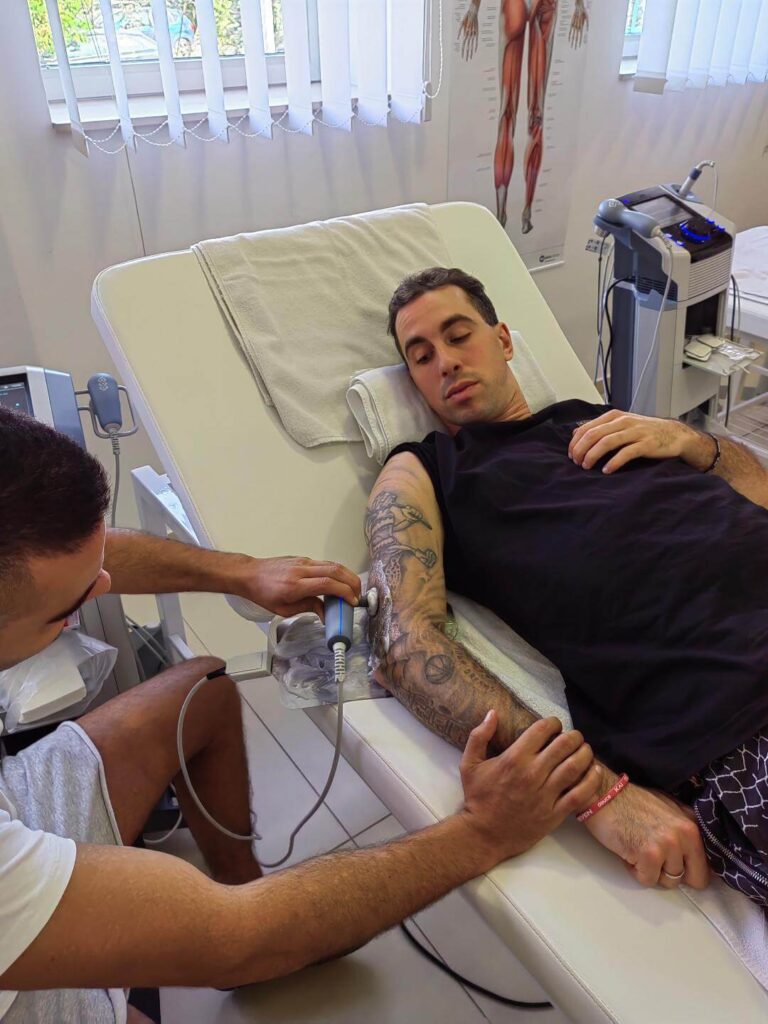
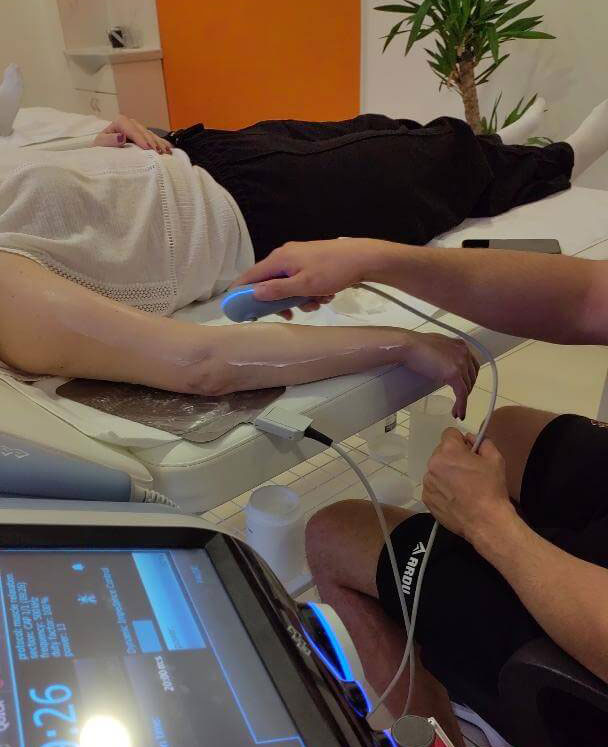
Physical therapy can include stretching, strengthening and stabilization exercises, massage, heat therapy or electrotherapy.
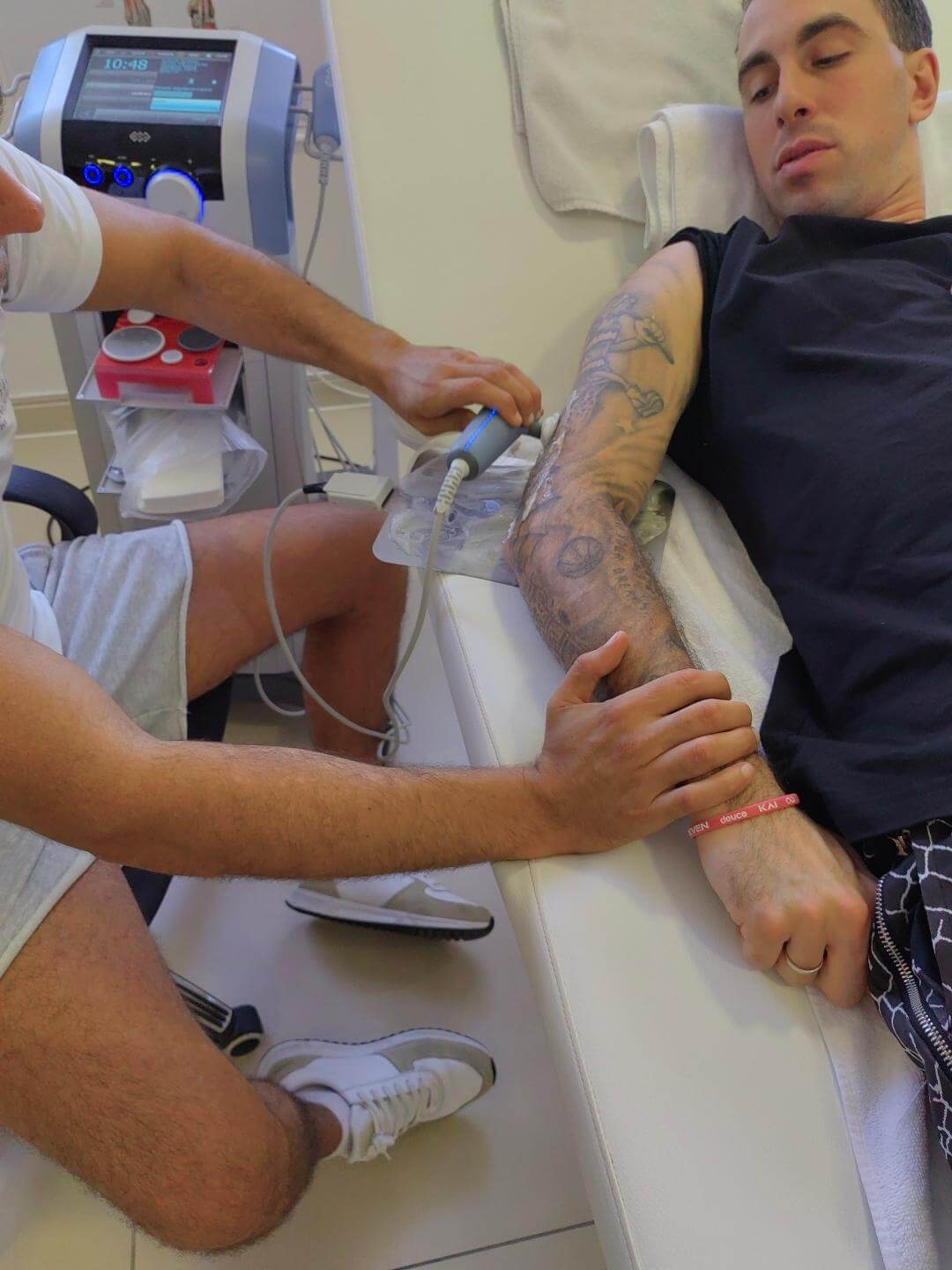
The use of devices such as lasers, interferential current, TENS and Tecar devices has proven very successful in eliminating acute pain.
In more severe stages of the condition (with subacute and chronic pain) the goal of therapy is to restore the joint's functionality with manual therapy and kinesiotherapy.
Also, elbow braces or compression bands and other orthopedic aids can provide additional support for a faster recovery.
If you want to prevent the onset of elbow pain, or if elbow pain is already a problem for you, our expert team with many years of experience and a large number of cured patients is at your disposal. Call us and book your first, completely free, appointment.
Related services and exams: kinesio taping, physical therapy, FMS testing. For an assessment and treatment plan book an examination or call 060/134-3303.
Book your first appointment for free!
When it comes to assessing the length of recovery, our team will determine and give the necessary guidelines for the fastest and best recovery. Not sure yet? You are just one click away from a free consultation.
Call now to book 060/134-3303
Related services: for elbow pain we recommend Tecar therapy and electrotherapy. To make an appointment book an examination.