
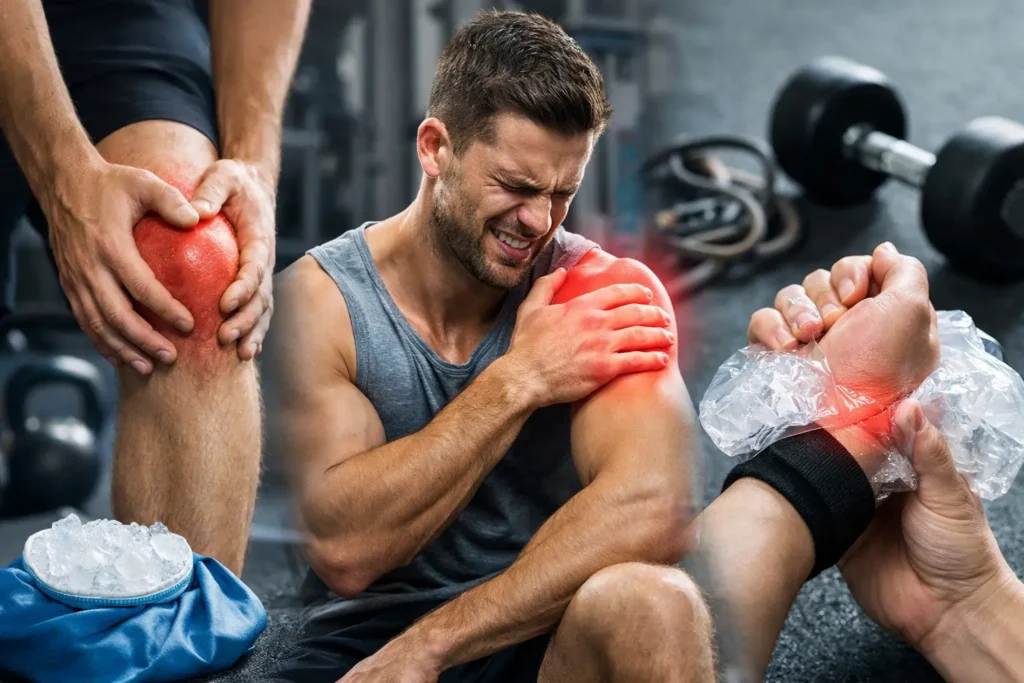
- Pain and swelling after training are most often a sign of overload or a mild injury.
- In the first 24h the goal is to reduce swelling and pain.
- Reduce the movements that provoke pain.
- Apply cold for 10-15 minutes, 2-4 times a day.
- Do not test the injury with a new training session.
- An examination is needed if you have severe swelling, deformity or numbness.
- If the pain comes back as soon as you start training, physical therapy can speed up recovery.
Note: This text is informational and does not replace an examination by a doctor or physiotherapist.
Why recreational athletes often get pain and swelling
Recreational athletes often train in waves. One week off. The next week too much. Tissue does not like sudden jumps in load. Poor technique and weaker stabilization make the problem worse. Lack of sleep slows down recovery.
What to do in the first 24h (universal)
- Reduce the load. Cut out movements that cause pain.
- Apply cold for 10-15 minutes, 2-4 times during the day. Do not put ice directly on the skin.
- Light compression can help with swelling.
- If you can, keep the leg/arm raised above heart level.
- Do gentle movements within a pain-free range, a few times a day.
What not to do in the first 24h: aggressive stretching through pain, strong massage directly over the painful spot, training on adrenaline and “testing” the injury by repeating the same movement.
When urgent care is needed (red flags)
- Sudden large swelling or deformity.
- Severe pain and inability to bear weight on the leg or to lift the arm.
- A feeling of “popping” at the moment of injury and marked instability.
- Tingling, loss of sensation, weakness of grip or a “cold” hand/foot.
- Fever, marked redness and warmth that is spreading.
Knee: pain and swelling after running, football or squats
The knee is often affected in recreational athletes. The triggers are running on a hard surface, sudden changes of direction, squats with heavy load and stairs. Most often it is tendon overload, irritation around the kneecap, or a mild injury after a “twist”.
What it usually looks like:
- Pain when going down stairs or in a squat.
- A feeling of pressure or tightness due to swelling.
- Discomfort when turning or changing direction.
First 24h – what to do:
- Pause squats, lunges and running. Walk shorter and slower.
- Apply cold for 10-15 minutes, several times during the day.
- If there is swelling, use light compression.
- Do gentle bending and straightening of the knee within a pain-free range.
When it is time for a physiotherapist:
- The swelling does not go down or increases over the next 24-48h.
- The knee “gives way” or you have a feeling of instability.
- The pain lasts longer than 5-7 days or comes back as soon as you run.
- You have “locking” or cannot normally bend/straighten the knee.
If your knee “gives way” or hurts when you walk, temporary stabilization can help while the irritation settles, especially through knee braces.
Shoulder: pain after bench press, overhead presses or swimming
The shoulder takes heavy loads in the gym and in throwing sports. In recreational athletes, tendon problems and pain when lifting the arm are common. It often gets worse when the shoulder blade does not have good movement control.
What it usually looks like:
- Pain when lifting the arm to the side or overhead.
- Pain in the evening or when sleeping on that side.
- A feeling of weakness when pressing or tightness in the front of the shoulder.
First 24h – what to do:
- Pause overhead presses, pull-ups and throwing.
- Apply cold for 10-15 minutes, 2-3 times a day.
- Do gentle movements back and forth within a pain-free range.
- Choose the arm position that hurts the least. Do not push through pain.
When it is time for a physiotherapist:
- You cannot raise your arm above shoulder level without stronger pain.
- The pain lasts longer than 7-10 days or keeps coming back after training.
- The pain is accompanied by weakness and a feeling of instability.
- The pain disturbs your sleep at night.
If your shoulder hurts even during ordinary daily movements, short-term support while you do exercises and reduce the load can sometimes feel good, such as shoulder braces.
Wrist: pain after push-ups, lifting weights, a fall or computer work
The wrist can swell after weight-bearing on the hand or repetitive movements. Triggers are push-ups, planks, lifting weights with a poor hand position, but also a fall onto an outstretched arm. In some people, long work with a mouse and keyboard also causes the problem.
What it usually looks like:
- Pain when bearing weight on the hand or when gripping.
- Tenderness and mild swelling around the joint.
- Sometimes tingling or a “tingling current” in the fingers.
First 24h – what to do:
- Avoid bearing weight on the hand and movements that provoke pain.
- Apply cold for 10-15 minutes, 2-4 times a day.
- Correct your hand position during work. Keep it neutral.
- Do gentle bending/straightening movements within a pain-free range.
When it is time for a physiotherapist:
- The pain lasts longer than 5-7 days or gets worse.
- Your grip is weaker and you cannot carry a light load.
- Tingling of the fingers, numbness or weakness keep coming back.
- The injury happened after a fall and the swelling is marked.
If you have to use your hand during the day, wrist braces can provide short-term relief and reduce pain during movement.
When physical therapy helps the most
If the pain keeps coming back, the problem is often not just “inflammation”. There is often weakness, poor movement control or limited mobility. In that case an exercise plan gives the best result.
In practice it most often starts with exercises through kinesitherapy, because it strengthens the stabilizers and restores safe movement.
When the goal is to reduce pain and speed up tissue recovery, tecar therapy is sometimes added, in agreement with the therapist.
For marked pain, tension and irritation, electrotherapy can also help, but always together with appropriate exercises and a recovery plan.
Return to training: 3 simple rules
- Pain should be mild (0-3/10) during movement. Sharp pain is a sign to stop.
- It must not be worse the next day. If there is more swelling or pain, the load was too early.
- Start with 30-50% of the load. Increase gradually over several sessions.
If pain and swelling follow you from one session to the next, get an assessment. Well-guided rehabilitation saves time and nerves.
Related services: for pain and swelling after training we recommend tecar therapy and electrotherapy. To book an appointment schedule an examination.